
 The sinking of the SS San Pablo—affectionately known to Northwest Florida locals as the “Russian Freighter”—is a story wrapped in wartime intrigue, local rumor, and military secrets.
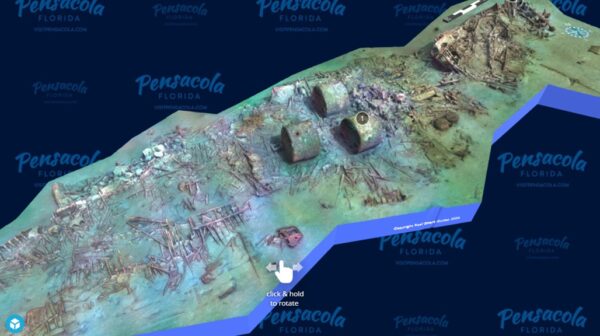
Today, this historic 315-foot (96-meter) vessel rests on the sandy seafloor off the coastline of Pensacola, Florida. Thanks to a new underwater mapping initiative, divers and maritime history enthusiasts can now explore a highly detailed 3D digital model of the debris field before ever dipping a toe in the water.
The History: From Fruit Cargo to Wartime Sabotage
Constructed in Belfast, Ireland, in 1915, the freighter spent the 1920s and early 1930s transport fruit between Central America and the United States. However, its peaceful cargo days ended abruptly during World War II.
-
July 2, 1942: While unloading at the docks in Port Limon, Costa Rica, the SS San Pablo was struck by two torpedoes fired from a German U-boat. The attack killed one American crew member in the engine room and 23 longshoremen working in the holds.
-
March 24, 1943: The wreck was refloated and towed to Tampa, Florida, where it was declared a total loss.
-
Early 1944: Towed to the Florida Panhandle for scrapping, the vessel was moored just offshore of Pensacola.
Spies or Secret Weapons?
The ship’s sudden appearance near Pensacola sparked intense local rumors that she was a Russian spy boat. These whispers turned into full-blown local legends when the vessel exploded under mysterious circumstances in August 1944.
Decades later, declassified U.S. military documents finally exposed the truth: the SS San Pablo was actually sunk during a top-secret weapons test involving a radio-controlled boat packed with 3,000 pounds of explosives. While she wasn’t a spy ship, the nickname “Russian Freighter” stuck forever.
What the 3D Wreck Map Reveals
Currently, the wreckage spans nearly 400 feet (122 meters) of sandy bottom. While it is an incredible Florida dive site, the complex jumble of iron and debris initially intimidated many divers.
To make the site more accessible, Visit Pensacola, alongside local operators and Reef Smart, prioritized mapping the site. The comprehensive 3D model is now featured on the Visit Pensacola website, alongside five other popular local shipwreck maps (click here to visit the site).
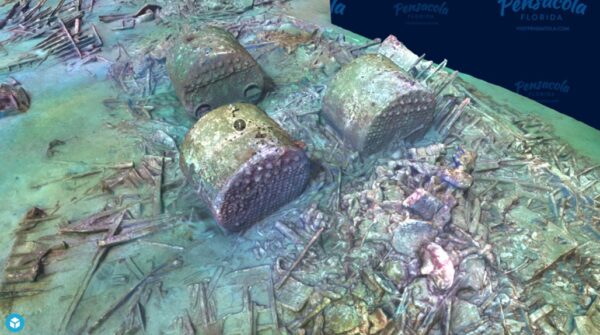 Virtual explorers and divers can look out for these distinct underwater landmarks:
-
The Three Boilers: Sitting high on the site, these iconic structures remain visible from almost any vantage point in the debris field.
-
The Bow Section: The bow has completely collapsed onto its starboard side.
-
The Stern: Mostly swallowed by the sand, the stern leaves a distinct, visible “hook” shape that contrasts clearly with the bow.
-
The Mast: Stretched out away from the bow, the collapsed mast rests visibly in the sand.
-
Refrigeration Coils: Scattered hull plates and the original coils used to keep fruit cool during its Caribbean transits litter the seafloor.
Click here to watch a video fly-through of the Russian Freighter.
Marine Life Note: The twisted metal has created a thriving artificial reef. It hosts one of the highest concentrations of toadfish in the region. Divers exploring the nooks and crannies are often serenaded by a distinct croak-croak-croak underwater chorus.
The Russian Freighter is an important site in the Florida Panhandle Shipwreck Trail. Click here to learn more about the 20 wrecks that make up the Shipwreck Trail. You can also purchase our custom waterproof dive slate and check these wrecks off your “hit list” as you dive them!
How the Underwater Map Was Made
Mapping a massive, scattered debris field like the Russian Freighter requires speed, precision, and the right tech.
The entire mapping process was completed in just two dives by a single diver. To cover the 400-foot site efficiently, Reef Smart utilized a Dive Xtras Black Tip Travel Diver Propulsion Vehicle (DPV) to navigate the site and capture data rapidly.
For the dive team, mapping the historic SS San Pablo was a bucket-list achievement—standing out as a premier heritage dive even when surrounded by world-famous Pensacola wrecks like the USS Oriskany.
Explore the interactive 3D model of the SS San Pablo on Visit Pensacola’s website here!