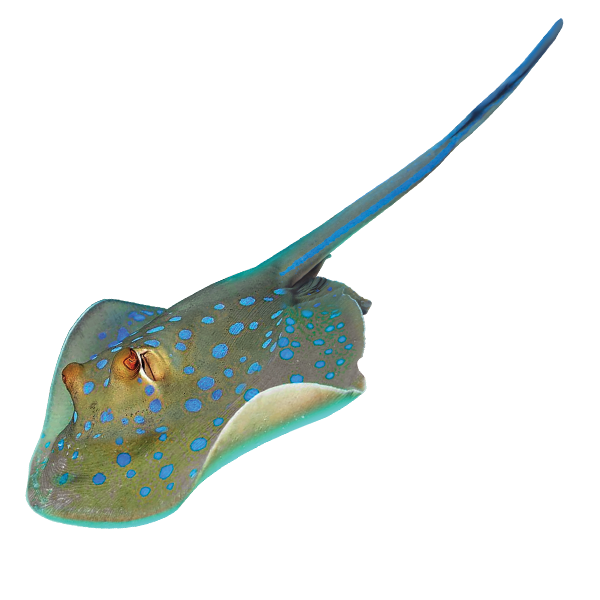
Taeniura lymma
Bluespotted ribbontail ray
Distribution:
Indo-West Pacific
Maximum Size:
Disc width up to 14 in (35 cm); total length up to 31 in (80 cm)
Longevity:
Up to 15 years.
Typical depth:
3–100 ft (1–30 m)
Behavior:
This strikingly colorful ray is a frequent sight on coral reefs, though it is notoriously shy around divers. Unlike many other stingrays that bury themselves deep in the sand, the bluespotted ribbontail ray often seeks shelter during the day under coral ledges, inside caves, or beneath shipwreck debris, frequently leaving its ribbon-like tail exposed. As the tide rises, they move in small groups onto shallow sandy flats to hunt. They use electroreception—sensing the electrical fields of living things—to locate prey like mollusks, crabs, and worms hidden in the sediment.
Predators:
Hammerhead sharks and bottlenose dolphins; also occasionally hunted by larger reef fish.
Did you know?
The brilliant neon blue spots on this ray’s back serve as “aposematic” coloration—a vivid warning to potential predators that the two sharp spines on its tail are highly venomous. If these barbs are broken off during a struggle, the ray has the remarkable ability to slowly regenerate them.